Sizing Up Your Business
White board exercises. A wall full of sticky notes indicating productivity. Swim lanes. Someone will screenshot the board and never look at it again.
Everyone knows the memes of design thinking that reign popular. They are the ones designers themselves have given the most heat. Rightfully so. Because a philosophical approach to thinking can’t be boiled down to a few icons. But human-centered design can be boiled down to one sentence—always keep the human experience at the center of everything. Sticky notes were never the point.
The point is design-thinking beats brand-centric thinking. Because design-thinking is actually just human-centered thinking applied to a problem. So, really, it’s human-centered design that wins all.
When I started working at ad agencies as a copywriter, I had a secret advantage when it came to healthcare work. I'd treated patients as a licensed acupuncturist and herbalist. Spinal disorders, diabetes, gout, you name it. Interned in hospitals, worked alongside all kinds of practitioners, and had my own tiny practice.
So when I heard our Hal Riney-alumni creative directors advocating for patient centeredness in a campaign, I thought that was the greatest thing I ever heard. It was easy creative work to fall in love with. The OneTouch More Power to You campaign wasn’t like the B.B. King campaign before it, glamorizing one person with a nonglamorous disease. Everyone living with the disease deserved the spotlight, not just the legend.
To me, this was a real brand doing a startup-style move of making it all about the people and the mission.
Think Like a Startup
See The World As A Startup Does is an excellent article from strategy+business. Businesses get in trouble when they start thinking like an institution (defending and managing risk) rather than an entrepreneur (focused on seizing opportunity and, of course, delightful UX experiences).
I was struck by the graphic for Sizing Up Your Business, which was based on Clayton M. Christensen and Mark W. Johnson’s "What Are Business Models, and How Are They Built?" Harvard Business School, 2009 (rev. 2021). While it remains an incredibly insightful and useful tool, here are 2 minor adaptations I’d offer for consideration.
The Resources label needs to be moved into a center shared area. Resources can’t always be controlled in the way the other elements can be. ‘People’ under Resources assumes the staff to do the job.
It should include organizational Human Centeredness. It’s been a key success factor for startups, their work, and their environments. Once upon a time Google was considered a startup. Their motto was Don’t Be Evil. They gave out a lot of free food. This stuff matters. I can’t help but remember Silicon Valley investors I once spoke with regularly. They all said they invested in the people and team first. They viewed that as the most important resource. But not in the sense of staff. It was people who could do the job and lead, and eventually solve the problem.
This is why HR is separate from finance and operations, why so many traditional companies work hard to get those ‘great place to work’ designations, and why there was a beware the ping pong table genre—exactly because so many people once said yes to a job because they saw a ping pong table. The ping pong table was a sign of a delightful work/life/play balance. At its time, ‘Don’t Be Evil’ was care. Free food and foosball decorate a workplace; a stated ethical commitment can guide and structure one.
I’d propose this version of the frame for Sizing Up Your Business. Please feel free to use it or adapt it.
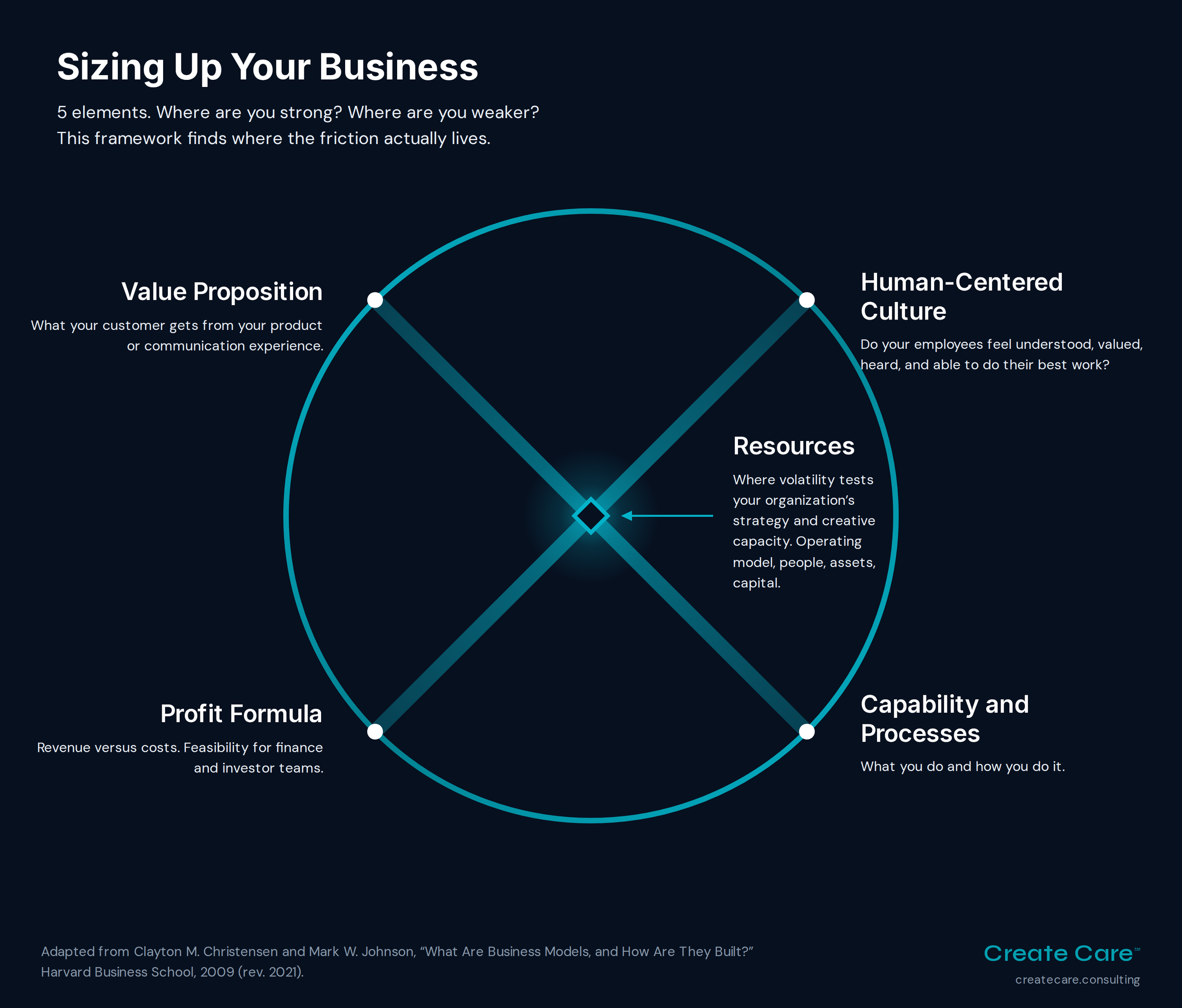
It’s a fascinating way to think about where the strengths and fault lines sit. ‘The message isn’t cutting through’ means something different if the data isn’t competitive, it’s a terrible product, or everyone hates working on the brand.
From $1.8 Billion to $9 Billion
What happens when a health system applies human-centered startup thinking to traditional healthcare?
We don’t have to wonder. From 2013 to 2021, Stephen Klasko ran Jefferson Health on the thesis that people are more than patients. In doing so, this eastern Pennsylvania health system went from $1.8 billion in revenue to $9 billion.
Jefferson Health designed "healthcare at any address" around Klasko's insight that 97% of people don't wake up thinking of themselves as patients. They just think of themselves as people who'd rather not let health get in the way. Seeing people as more than just patients—as people who wanted to thrive—and meeting them where they were really at (mentally and physically) changed everything.
Delight decorates. Care scales.
And when it comes to healthcare, care isn't a feature request. It's half the word.